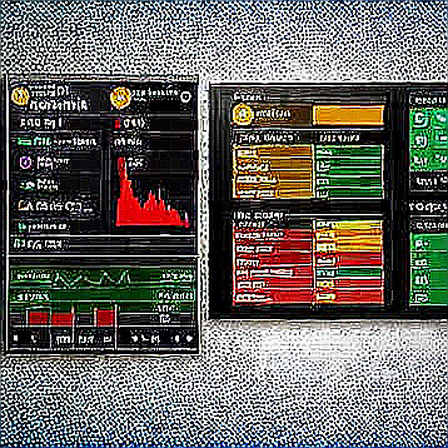
SanDisk jumps 4.3%. Micron rises 3%. Western Digital and Seagate climb over 2.6%.
These ticks on the US pre-market board aren’t just another cyclical upswing in a commoditized industry. They are a signal—one that carries an uncomfortable truth for anyone building decentralized infrastructure: the demand for storage is exploding, and the world is betting on centralized giants to fulfill it.
We code the trust, but we must audit the soul.
Context: The Ledger We Don't Control
The storage industry—NAND Flash, DRAM, HDD—is undergoing a structural shift. For years, it moved in predictable cycles: oversupply, price crash, consolidation, recovery. But the current upturn feels different. The catalyst isn't just a seasonal restock. It's AI.
Every AI model training pipeline requires massive, low-latency memory. HBM (High Bandwidth Memory) is sold out for the next 18 months. Enterprise SSDs are being snapped up by cloud hyperscalers. Even HDDs, long written off as dying tech, are seeing a renaissance thanks to Seagate’s HAMR technology enabling 30TB+ drives for archival AI data.
Meanwhile, the blockchain world talks about decentralized storage—Filecoin, Arweave, Storj. These protocols offer cryptographic guarantees of data integrity, fault tolerance, and censorship resistance. But the market cap of all decentralized storage tokens combined is a rounding error compared to the valuation of Micron, SanDisk, or Seagate.

Proof is binary; meaning is fluid. The market is pricing in a future where data is stored in centralized silos, controlled by a handful of IDMs (Integrated Device Manufacturers). The decentralized alternative remains a niche experiment.
Core: The Hidden Price of Centralized Performance
Let’s dissect what the stock moves are actually telling us. The rally isn't just about higher prices for memory chips. It's about three deeper trends:
1. The AI Storage Monster Every AI chip (NVIDIA H100/B200, AMD MI300X) is bandwidth-hungry. HBM3e is the bottleneck. Micron, with its 1β DRAM process and advanced packaging, is the primary Western beneficiary. SanDisk, riding the enterprise SSD wave, benefits from AI training data needing fast local storage. This creates a dependency chain: AI → HBM → NAND → HDD. All controlled by centralized suppliers.
2. Supply Concentration Risk The top three NAND makers (Samsung, Kioxia/WD, Micron) control 70%+ of the market. In HDD, Seagate and WD collectively hold over 80%. This oligopoly can dictate prices and availability. For a decentralized network that relies on cheap, abundant storage (Filecoin's retrieval market, Arweave's permanent data), this concentration is a risk. A sudden price spike or trade restriction could destabilize network economics.
3. Geopolitical Fragility The analysis points out that US export controls on equipment (ASML, Applied Materials) and potential Chinese retaliation (rare earth restrictions) threaten these companies. A ban on high-tech components to China could disrupt manufacturing for months. For blockchain protocols that depend on globally distributed storage providers, a disruption in the supply of cheap storage hardware would break the promise of censorship resistance.
The protocol is neutral, but the user is human. The market is betting that these centralized bottlenecks will be solved by more capital, not by decentralization.
Contrarian: Is Decentralized Storage Really the Answer?
Here’s the uncomfortable part: the market might be right—in the short term.
Let’s be honest. Filecoin’s storage utilization is still a tiny fraction of its capacity. Arweave’s permaweb struggles with mainstream adoption. The user experience of retrieving a file from a decentralized network is slower and more complex than hitting an AWS S3 bucket. For AI workloads that need millisecond latency, decentralized storage today is simply not competitive.
We are not moving money; we are moving belief. The stock market’s belief is that centralized memory will scale faster, cheaper, and more reliably than any decentralized alternative for the next 3-5 years.
But that belief overlooks a critical flaw: centralization breeds single points of failure. If a trade war locks Micron out of a key market, or a factory fire at a Kioxia plant cuts global NAND supply by 10%, the entire AI economy stumbles. Decentralized storage, with its distributed network of providers, does not have that vulnerability. Yet, the market ignores this because it values performance today over resilience tomorrow.
Takeaway: The Decentralist’s Opportunity
The SanDisk 4.3% jump is a wake-up call. It tells us that the demand for digital memory is entering a super-cycle driven by AI. That wave of demand will first flood the centralized incumbents. But as data sovereignty becomes a political issue (right to delete, right to audit), and as the cost of trust failures (data leaks, censorship, service shutdowns) accumulates, the pendulum will swing back.
In a world of ledgers, who holds the memory? The protocols that solve for trust, not just speed, will eventually capture value—but only if they survive the current bull run in centralized hardware. For now, we watch the pre-market ticks and build. The chain doesn't forget, but it must also learn to wait.
--- Based on my experience auditing governance contracts in 2017, I learned that the most dangerous failures don't come from code bugs—they come from unexamined dependency on centralized inputs. The same logic applies to storage.